
Change can be a difficult thing. As I grow older, I begin to understand why previous generations often continued to do things as they had always done: balancing checkbooks, mailing bills, keeping familiar routines, and resisting the disruption of something new. Only recently, I found myself frustrated that Google had changed the icons for its products, so that the small image in my browser tab was no longer immediately recognizable. Such moments remind us that change is often inconvenient, sometimes disorienting, and rarely welcomed at first. Yet change is also necessary. To reject all change is to assume that nothing can be improved.
The PCA is looking at a Proposed Directory for Worship. This proposal will come before the General Assembly this year for a vote, and, depending on the outcome, will be sent to Presbyteries for consent and ratification at the next GA. I plan to walk through this proposal with an overview in subsequent writings, looking at the proposal chapter by chapter, highlighting some of the proposed Directory’s strengths and some of its areas for improvement (minor). I might also write a personal critique of what I believe could be improved throughout the Directory (although I hope this will not be a speech against it). However, I want to give a brief introduction to Directories in general and provide some specific advice for reading.
Historical setting
After the signing of the Solemn League and Covenant, the Westminster divines were tasked with a large project, one part of which was seeking greater uniformity in worship across the three kingdoms.
“That we shall sincerely, really, and constantly, through the grace of GOD, endeavour… to bring the Churches of GOD in the three kingdoms to the nearest conjunction and uniformity in religion, confession of faith, form of church-government, directory for worship and catechising; that we, and our posterity after us, may, as brethren, live in faith and love, and the Lord may delight to dwell in the midst of us.”1
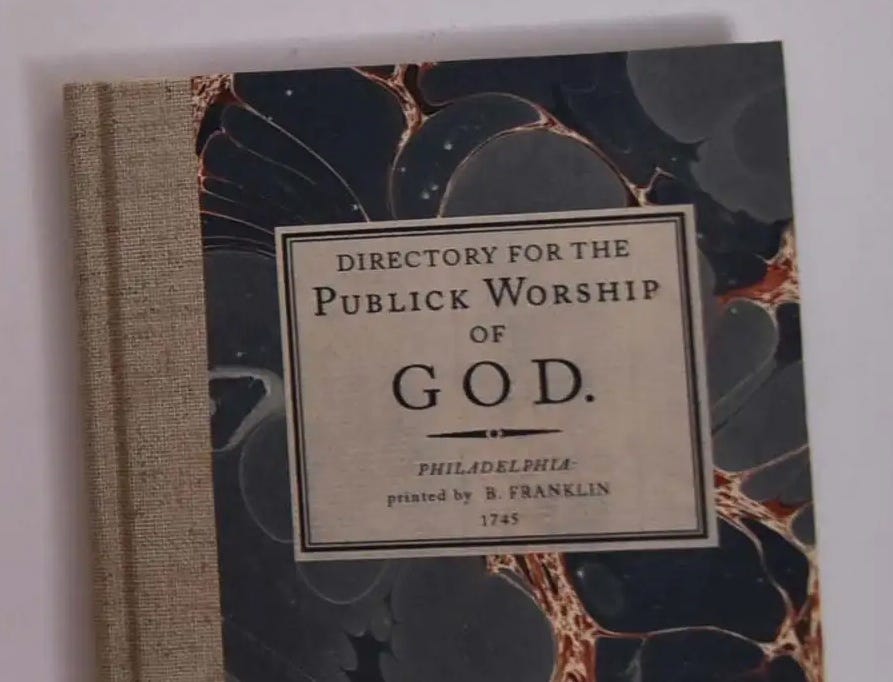
In their wisdom, they did not prepare a prayer book or liturgy, but a Directory for Worship. A tool to help guide ministers in worship. You can see a summary of the arguments the Westminster Assembly had for changing from a service book to a Directory.
The documents written by the Assembly in the 1640’s have continued to be used by Presbyterians across the globe. This is true of American Presbyterians, in 1729 the Adopting Act was passed, and in the same year, the synod passed this motion,
“The Synod do unanimously acknowledge and declare that they judge the Directory for worship, discipline, and government, commonly annexed to the Westminster Confession, to be agreeable in substance to the word of God, and founded thereupon, and therefore, do earnestly recommend the same to all their members, to be by them observed, as near as circumstances will allow, and Christian prudence direct.”2
Eventually, they would write their own version of the Form of Government and Discipline (1788). While the Confession has had minor changes (1788 and 1903), the Directories have had multiple changes and variations. Many seeds came from the one Directory (1645). 3
The American Directory, within the branch of American Presbyterians stemming from the first Presbytery in 1706,4 and extending to what is now the PCA, has undergone several revisions and changes. The first proposed revision was presented in 1786, along with the Form of Government and Rules of Discipline. The proposal was about 23,000 words, much longer than the Original (about 13,800 words). The proposal was sent back, and a new committee was assigned to work on it. John Witherspoon and others later presented a much shorter Directory, about 7,000 words, which was adopted and became the standard Directory for American Presbyterians. I have sought to compare some of the variations in the Directories from American Presbyterian History.
Interesting changes
We could not list all the changes in a single article. Some are major and others minor. Writing about what American Presbyterians have done is easy; they keep accurate minutes of their actions, so the Historian can say this is what they passed or failed. However, determining why it passed or failed is difficult.
We can see changes, such as older practices, such as
As it has been customary, in some parts of our church, to observe a fast before the Lord’s supper; to have a sermon on Saturday and Monday; and to invite two or three ministers on such occasions; and as these seasons have been blessed to many souls, and may tend to keep up a stricter union of ministers and congregations, we think it not improper that they who choose it may continue in this practice.
This would become the Current PCA BCO 58-8:
As past custom has been found in many parts of the Presbyterian Church, our congregations are urged to have a service of spiritual preparation for the Lord’s Supper during the week previous to the celebration of the Sacrament.
Or changes to Visiting the Sick:5
If the sick appears to be a stupid, thoughtless and hardened sinner, he shall endeavour to awaken his mind; to arouse his conscience… (1789)
Or a failed amendment, such as this terrific membership vow (1891):
Do you engage to be diligent in the use of the means of grace, such as prayer, the reading of the Scriptures, and devout attendance on the public worship and ordinances of God’s house?
Or one that was not included in the 1933 version,
There is no day under the gospel commanded to be kept holy, except the Lord’s day, which is the Christian Sabbath.
So when reading changes, we should do so in light of history. One of the biggest changes in the proposed Directory is the shift from pious advice (except for three chapters and one section) to the constitutional Directory. The Directory should be read in context as a historical document that helps direct, not dictate, principles of worship for the Denomination. While not perfect, I believe this tool, in the hands of sessions who prudently read, pray, study, and apply it to their congregations, will be a great blessing to the church for generations to come. As I have read and studied this text along with my historical research of Directories, I believe this is one of my favorites. While we could survey the plethora of Directories and choose favorite lines or phrases, we will never be satisfied.
The Proposed Directory is a tremendous resource that will serve the PCA well for generations to come. While I think it could be improved in some lines (try to point them out in my further articles). It is a blessing and needs to be read as a whole.
Pieces of advice
Now the penny is no longer being minted, my two cents are less valuable than they were before, but I will at least provide some thoughts as you read, study, pray, and consider the Proposed Directory.
Read the Directory as a Whole
Do not read this merely by searching for what is missing. Read it as a whole. Many people, myself included, will find particular places where they wish the Directory spoke more clearly or directly. I see missing lines or phrases that were present in older versions, which I was not opposed to. While I might like particular lines in the Third (out of Six) Revision of the Directory, that lead to the 1894 revision, such as “The great principle, defining the limitations upon public worship, is, that whatsoever is not either explicitly commanded in the word of God, or cannot be deduced from it by good and necessary consequence, is forbidden.”6 However, that does not mean I would vote for the Directory as a whole. If we are looking for a Directory that we 100% agree with, then there is no such document. In a denomination with 400,000 members, no document would ever pass.
When comparing historical revisions, we can look at what is missing; some might be deliberate, others based on priorities/space, and some accidental. We might not know with great detail which of these is the case. The Proposed Directory will omit some lines from historical versions; however, it includes many lines and sections that are significant improvements over other versions (I hope to point out some of them). The Proposed Directory has great, theologically rich, and confessionally deep instruction in Worship that is found in the streams of Reformed Presbyterianism. I will try to point these out in subsequent articles, but read the current version on Visiting the Sick, and then the proposed Directory’s Chapter on the same. I believe many people will see the improvement. You can do the same with every chapter, and I believe you will see a great richness in the Proposed Directory.
While helpful to see them side by side, I believe people will be better served not by seeing what they want written, but by reading and asking, “Will this serve the church well?” In subsequent years, we can send amendments to help craft a better Directory. But I do believe the changes would be more perfecting than revising.
Do not Pick and Choose
Secondly, my advice is not to turn to this merely to see whether your current practice is allowed, if you have no plan to read, study, and implement what is said. As I read through this Directory, it puts forward a positive direction for the heritage of Presbyterian worship as found in the Bible. The PCA, while evangelical, finds its roots in the southern Presbyterian tradition that saw worship as the perfecting of the saints. Many in the PCA do not come from a long line of catechized children and generations of elders. Many in the PCA have turned from a variety of traditions and denominations, or from a lack thereof, and have found beauty in the Reformed view of salvation and even in the form of government. I believe one of the greatest gifts that Presbyterians give is their simplicity of worship found in the outward and ordinary means of grace. Reformed Presbyterian Worship is where:
-
The doctrines of grace are displayed in the centrality of the preached Word, by which God convicts and convinces sinners and draws them to Christ.
-
The covenant of grace is visibly administered in baptism, as God sets his name upon his people and seals his promise to believers and their children.
-
The government of Christ’s church is exercised as the session shepherds the souls entrusted to them by the great Shepherd of the sheep, equipping the saints for the work of ministry.
-
The second commandment is honored as Christ is not represented by man-made images or traditions, but by the sensible and visible signs he himself appointed in the Lord’s Supper.
-
The life of prayer is practiced as the gathered people of God lift up their hearts to the throne of grace, seeking mercy and help from their covenant Lord.
-
The Trinitarian nature of worship is confessed as the people come to the Father, through the Son, by the power of the Holy Spirit.
-
And all of this rests upon the foundational truth that Christ alone is Head and King of his Church.
This Directory encourages sessions to move in this direction without many ‘shalls’ or ‘shall-nots.’
While the PCA might not change overnight, I pray that everyone, myself included, would read and study the Proposed Directory in light of Scripture and the Standards, and slowly teach and instruct the congregation in the beauty of Reformed Presbyterian worship. The Proposed Directory draws not only from the current PCA Directory but also from the 1645 Directory and the many Presbyterian directories that flow from this rich heritage.
Conclusion
Lastly, I want to commend the Proposed Directory to the Assembly. I am grateful for the labors of the men who have served; it is not an easy task to write such a document. They have done a tremendous job of writing these chapters for us to vote on. While not perfect, we must understand that our current one is not perfect either, particularly the temporary statement that is entering into the empty-nest stage of life. Even a non-controversial chapter of preaching could not pass a single General Assembly by a majority vote. For some men, this will be an easy decision to vote for the Proposed Directory. While others might find the Proposal does not go far enough. For men, I hope you will see this document as one step towards a stronger, unified PCA. Each will need to make a decision after reading, prayer, and study. This decision will have many factors, such as would you rather a unconstitutional directory (that is not perfect), or would you rather a constitutional directory (that is not perfect), but does give positive encouragement to sessions to apply the heritage of reformed Presbyterian worship to the congregation they are called to serve. I hope my following articles will show that the Proposed Directory will be a great blessing to the Presbyterian Church in America.
Westminster Assembly, The Westminster Confession of Faith: Edinburgh Edition (Philadelphia: William S. Young, 1851), 465.
Charles Hodge, The Constitutional History of the Presbyterian Church in the United States of America, Part I (Philadelphia: William S. Martien, 1839), 173–174.
For more on the Westminster Directory for Worship and its American Presbyterian revisions, see Thomas Leishman, ed., The Westminster Directory (Edinburgh and London: William Blackwood and Sons, 1901), a useful edition of the Directory with historical introduction, notes, and appendices; Frederick Walker McNally, “The Westminster Directory, Its Origin and Significance” (Ph.D. diss., University of Edinburgh, 1958), a fuller study of the Directory’s historical setting, theological principles, and relation to earlier Scottish and English forms of worship; and Stanley R. Hall, “American Presbyterians and the Directory for Worship, 1645–1989,” American Presbyterians 72, no. 2 (Summer 1994): 71–85, which traces the adaptation and revision of the Directory in American Presbyterian churches through the modern period.
The precise date of the organization of the first American presbytery cannot be fixed with certainty. The original Minute Book of “The Presbytery” is extant, but its first leaf is missing and the surviving record begins with page 3. For that reason, historians have generally dated the organization of the Presbytery of Philadelphia to 1706, while noting that, if the meeting occurred before March 25, it would have been reckoned as 1705 under the old English civil calendar and 1706 under the historical calendar now in use. See Benjamin L. Agnew, “When Was the First Presbytery Organized?” Journal of the Presbyterian Historical Society 3, no. 1 (1905): 13–29, esp. 15, 23–24.
The Proposed Directory Chapter on ‘Visiting the Sick’ is a tremendous improvement from the current PCA Directory.
“The Third Revision of the Directory of Worship,” Southern Presbyterian Review 36, no. 2 (April 1885): 343–366, esp. 345.