
X, formerly known as Twitter, can be a whirlwind. In recent days, a discussion has arisen regarding stated differences, mainly concerning the use of images of Christ for artistic or pedagogical purposes. This discussion has occurred before, and there are many good resources that I believe support the Reformed/Westminsterian position.
One of the best short articulations of the argument that images of Christ strike at the vitals of religion can be found in the Confessional Presbyterian, by Dr. Harrison Perkins, “Images of Christ and the Vitals of the Reformed System.” Dr. Perkins briefly touches on the argument in this article. Many arguments can be made for the prohibitions of images of the Second Person of the Trinity (Eg, Faith No Fancy, R. Erskine). This article is not exhaustive, nor is it the sole reason why candidates and ordained men should reconsider their stated differences.
Before I begin, I believe the Westminster Standards do not go too far in their exposition of the Ten Commandments. I believe they are applying the interpretive method of ‘good and necessary consequence’ (WCF 1.6). I also believe they are consistent with their principles of interpretation as set out in WLC 99. When reading the commandments in isolation, this narrows our interpretation and application of them. I understand that people state their differences with the Westminster Standards concerning the second commandment. Although they might appear rational arguments in their minds, I believe they are inconsistent in their theological definitions, severing Christology from the application of the commandment. I pray my article might provoke thought in all of us, leading us to see the beauty of the incarnation, to know the Person, Jesus Christ, and to worship him.
In this article, I hope to be able to show that images of Christ are hostile to the system of doctrine because they treat the person of the Son as capable of being contained in a man-made image, whereas orthodox Christology insists that His person subsists in the inseparable union of the divine and human natures, and therefore cannot be represented without distorting the unity of His person.
Gregory of Nyssa rightly explains in his writing ‘Not Three Gods’ that, “In truth, the question you propound to us is no small one, nor such that but small harm will follow if it meets with insufficient treatment.”1 Wrapping our finite minds around the infinite true and living God is impossible. There is no small question when speaking about God, and even the smallest of questions, if not correctly handled, can fall into heresy and blasphemy. As Gregory of Nyssa states, the harm from insufficient treatment is no small matter. We therefore need to consider the implications of these truths before stating our differences, and be willing to defend them.
Francis Turretin said, “In the Christian religion there are two questions above all others which are difficult. The first concerns the unity of the three persons in the one essence in the Trinity; the other concerns the union of the two natures in the one person in the incarnation.”2 It is great comfort to us that great minds like these and many others explain the difficulty of seeking to understand the Triune God revealed to us in His Holy Word. We also need to be reminded that God has not left us without his word, by which he reveals himself to us, so that we may know him and worship him. Therefore, both our knowledge of God and any claim to represent Him must be governed by His Word, not by the inventions of our imagination.
Definitions
Nature is what something is, its set of essential properties. When we speak of the Godhead, we use the term essence, the essence of the divine. Turretin defines it this way, “First, here occurs the word ousias or “essence” and “nature” which denotes the whatness (quidditatem) of a thing and is often met with in Scripture, not only in the concrete when God is called ho ōn (Ex. 3:14; Rev. 1:4), but also in the abstract when deity (theotēs, Col. 2:9), nature (physis, Gal. 4:8), divine nature (theia physis, 2 Pet. 1:4) is attributed to God.”3
Person is who someone is, a subsisting subject who acts. Turretin explains it this way, “The word “person” is properly concrete and not abstract. Besides the form (which is personality), it also marks the subject with the form from which it is denominated.”4
The Hypostatic Union is God the Son, second person of the Trinity, subsisting of the divine nature, taking on flesh, the human nature in the fullness of time. Stemming from the Greek word, ‘ὑπόστασις’ literally means, “ that which stands under.” When we speak in Christological terms, we refer to a distinct personal subsistence; yet the human nature of Christ is not a distinct personal subsistence, but subsists in the person of the Son.5 This is why it is important to understand the Triune God, as the essence of God does not take on the nature of man, in that the Trinity becomes incarnate, but the Person of the Son, who is of the same substance as the Father and the Spirit, takes on his human nature. The Person is united to the Nature, not the Essence united to the nature.
Anhypostasia (ἀνυποστασία) teaches that the human nature of Christ has no independent personal subsistence of its own; it was never, even for a moment, a human person standing alone. This guards against Nestorianism, which wrongly posited two persons in Christ loosely conjoined.
Enhypostasia (ἐνυποστασία) is the positive complement; the human nature, though lacking its own independent hypostasis, is not therefore impersonal or deficient, because it truly and fully subsists in the person of the eternal Son. This guards against Apollinarianism, which wrongly taught that the Logos displaced or replaced a component of the human nature, leaving it incomplete.6
Together, these doctrines establish that Christ’s human nature is neither a separate subject nor an abstract component, but truly exists only in the person of the Son. Therefore, it cannot be isolated, conceived, or represented independently without distorting the unity of His person.
The Westminster Confession states the Biblical Doctrine of hypostatic union,
“The Son of God, the second person in the Trinity, being very and eternal God, of one substance and equal with the Father, did, when the fulness of time was come, take upon Him man’s nature, with all the essential properties, and common infirmities thereof, yet without sin; being conceived by the power of the Holy Ghost, in the womb of the virgin Mary, of her substance. So that two whole, perfect, and distinct natures, the Godhead and the manhood, were inseparably joined together in one person, without conversion, composition, or confusion. Which person is very God, and very man, yet one Christ, the only Mediator between God and man” (WCF 8.2).
Turretin says,
“It may be called a part also analogically and in a wider sense; not as if the person of Christ is compounded or consists of two incomplete natures, as parts properly so called (which would savor of imperfection); but because it subsists not in one, but in two natures and agrees with both; not accidentally, but essentially.”7
Again Turretin,
“That is, did the Son of God, the second person of the holy Trinity, join together with himself in unity of person, not a person, but a human nature; not by conversion and transmutation, but by assumption and sustentation, so that the Son of God was made the Son of man and our Mediator and is truly God-man.”8
Inseparably joined together
The Confession states clearly,
“So that two whole, perfect, and distinct natures, the Godhead and the manhood, were inseparably joined together in one person, without conversion, composition, or confusion.”
The Confession carefully defines its terminology, affirming that the two natures, the Godhead and the manhood, are inseparably united in one person. They are not two natures, to two persons, nor one person and half natures. The Reformation did not create new categories or theological terms but used the Catholic (universal) teaching of the Church as taught in Scripture (WCF 1.10). The Assembly is repeating what has been stated before by the early church fathers and the Chalcedonian definition,
“Following, therefore, the holy fathers, we all teach with one accord one and the same Son, our Lord Jesus Christ, perfect in His Godhead and perfect in His manhood, true God and true man, consisting of a reasonable soul and of a body, of one substance with the Father as touching the Godhead, and of one substance with us as touching the manhood, like unto us in everything, sin excepted, according to the Godhead begotten of the Father before all time, but in the last days, for us men and for our salvation, according to the manhood, born of the Virgin Mary, the God-bearer, one and the same Christ, Son, Lord,—only-begotten, confessed in two natures, without confusion, without change, without rending or separation; while the difference of the natures is in no way denied by reason of the union, on the other hand, the peculiarity of each nature is preserved, and both concur in one Person and Hypostasis.”9
Briefly, the humanity of Christ does not subsist independently, but only in the person of the Son. This union was therefore “inseparably joined together in one person.” The WCF states that one cannot separate Christ’s human nature from the second person of the Triune God. It is not a detachable or isolatable object, but the humanity of the Son. As Francis Turretin rightly insists, “what the Logos (Logos) has once assumed he never laid aside.”10 The humanity, therefore, is never presented apart from the person, but always as personally united to Him; and because the person of the Son has always subsisted in the divine essence from all eternity, the natures cannot be separated.
Use of images
This is where brothers who take exception to the images of Christ are inconsistent. I have heard many arguments and read many stated differences.11 However, one argument that is often made is that pictures of Jesus Christ are not forbidden, for pedagogical and artistic reasons (or more specifically, images of Christ are permissible, in most circumstances if they are not worshipped). This is articulated and supported by the image, which depicts Christ’s humanity, not his deity. His human nature is depicted, not his divine nature. However, this strikes at the vitals of religion because it separates what has been inseparably joined together in one person. The nature (what-ness) is always connected to the person (who-ness). You cannot depict humanity without depicting a person. Even in our use of language, we see this. A child stating, “I drew human nature.”12 Even if the human is ambivalent, the correct use would be, “I drew a human.” The nature of a human is attached to a person, even if unnamed. When one attempts to draw Christ, one does not merely depict a human nature, but the person of the Son himself; and that person, as the eternal Second Person of the Trinity, subsists inseparably in both divine and human natures, and therefore cannot be represented by any created image, stemming from human imagination. This stands in contrast to the incarnation itself, wherein the Son, who is the image of the invisible God, reveals Himself according to His own will, something no creature can replicate.
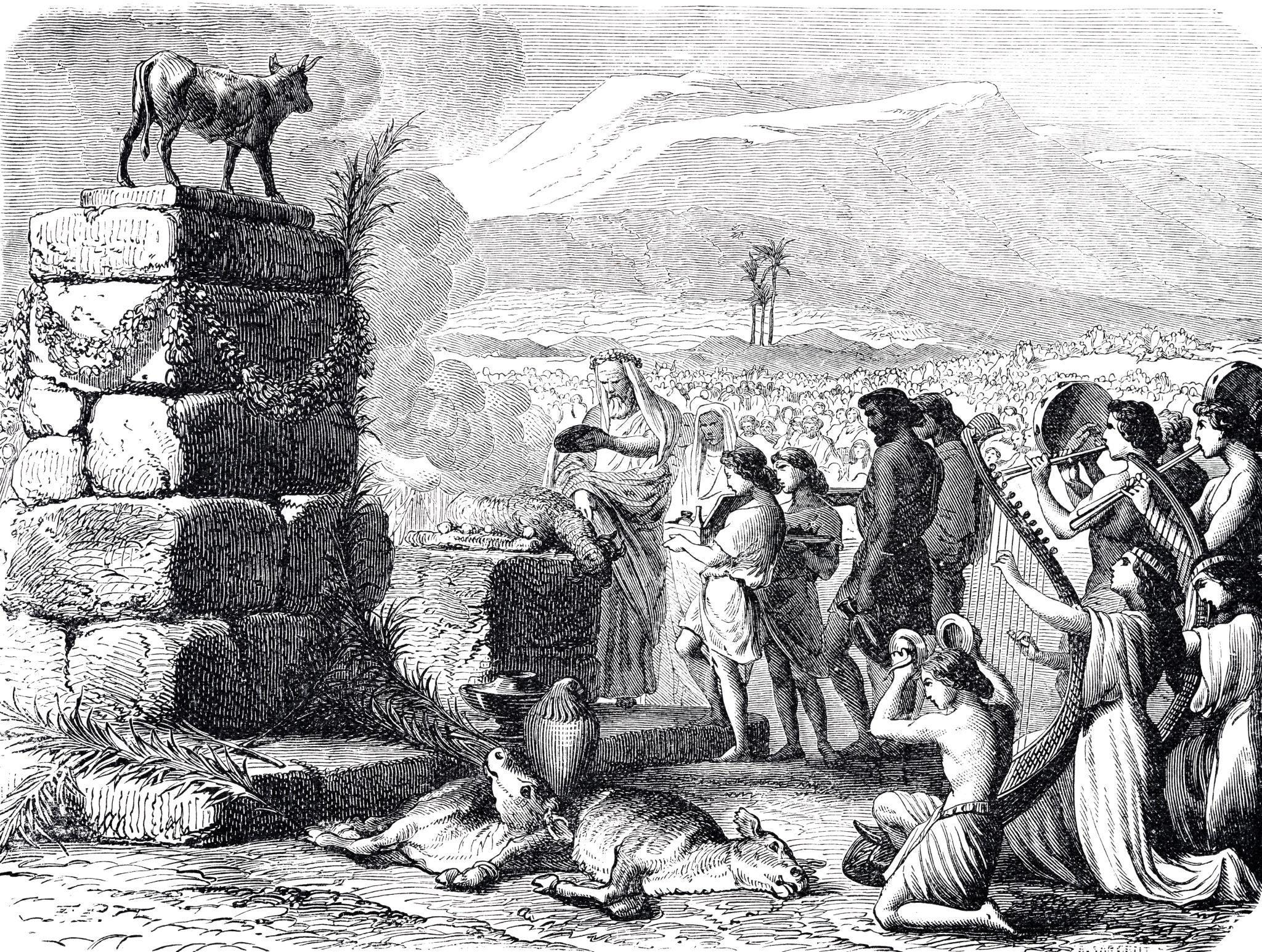
Calvin’s well-known statement that the human heart is “a perpetual factory of idols”13 is often cited broadly, but in its original context, it arises specifically within his critique of images of God. This tendency is not abstract, but deeply rooted in the history of God’s people. Not long after the Lord manifested Himself from the mountain without form, the people of Israel fashioned a golden calf, declaring it to be the God who brought them up out of Egypt. In his Sermons on Deuteronomy, Calvin writes,
“And can a man devise to tear the Majesty of our Lord Jesus Christ, and to deface his glory more, than by things that the Papists do? Behold, they paint and portray Jesus Christ, who (as we know) is not only man, but also God manifested in the flesh: and what a representation is that? He is Gods eternal son in whom dwells the fullness of the God head, yea even substantially. Seeing it is said, substantially, should we have portraitures and images whereby the only flesh may be represented? Is it not a wiping away of that which is chiefest in our Lord Jesus Christ, that is to wit, of his divine Majesty? Yes: and therefore whensoever a Crucifix stands mopping & mowing in the Church, it is all one as if the Devil had defaced the son of God.”14
John Owen expresses this argument more completely, “All this is done in the person of Christ. He is the complete image and perfect representation of the Divine Being and excellencies. I do not speak of it absolutely, but as God proposeth himself as the object of our faith, trust, and obedience.”15 Owen makes it clear that the Second Person of the Trinity assumed human nature so that we might know God and worship Him rightly. God, knowing man’s inclination to exchange the truth about Him for a lie (Rom. 1:21ff), has given us Christ as the true and living revelation of Himself. Because of our weakness and inability to behold the fullness of God’s glory directly, the Lord has graciously given us to know Him in Christ: “For considering our weakness as to an immediate comprehension of the infinite excellencies of the divine nature, or to bear the rays of his resplendent glory, seeing none can see his face and live, it is the most adorable effect of divine wisdom and grace, that we are admitted unto the contemplation of them in the person of Jesus Christ.”16
Later in his works, John Owen applies this reason to images of Christ, where he says,
“And, by the way, we may see hence the vanity as well as the idolatry of them who would represent Christ in glory as the object of our adoration in pictures and images. They fashion wood or stone into the likeness of a man. They adorn it with colours and flourishes of art, to set it forth unto the senses and fancies of superstitious persons as having a resemblance of glory…and so propose it as an image or resemblance of Christ in glory. But what is there in it that hath the least respect thereunto,—the least likeness of it? nay, is it not the most effectual means that can be devised to divert the minds of men from true and real apprehensions of it? Doth it teach anything of the subsistence of the human nature of Christ in the person of the Son of God? nay, doth it not obliterate all thoughts of it! What is represented thereby of the union of it unto God, and the immediate communications of God unto it? Doth it declare the manifestation of all the glorious properties of the divine nature in him? One thing, indeed, they ascribe unto it that is proper unto Christ,—namely, that it is to be adored and worshipped; whereby they add idolatry unto their folly.”17
As Owen so often does, he drives us to the person of Christ Himself as He is revealed in the Word—the true and whole Christ: the Second Person of the Trinity, in whom the divine and human natures subsist inseparably and cannot be severed. We need the God-man for our salvation, for our knowledge of God, and even for our apprehension of his true beauty. No image can present this Christ. A picture that depicts only His humanity is, at best, theologically impossible, and at worst, blasphemous. For when would we ever need or desire an image that does not present the person of the Son?
Many more reformers could be quoted here, but I will finish with Thomas Watson, who applies the same logic in his Body of Divinity,18, “If it be not lawful to make the image of God the Father, yet may we not make an image of Christ, who took upon him the nature of man? No… It is Christ’s Godhead, united to his manhood that makes him to be Christ; therefore to picture his manhood, when we cannot picture his Godhead, is a sin, because we make him to be but half Christ,—we separate what God hath joined,—we leave out that which is the chief thing, which makes him to be Christ.”19
Conclusion
I hope this article serves as kindling to spark further reflection and, above all, a deeper sense of wonder at the glory of the gospel. My aim has been to show, even briefly, that images of Christ are hostile to the system of doctrine, because they treat the person of the Son as capable of being contained in a man-made image, thereby separating what God has inseparably joined together, the divine and human nature subsisting in the one person of Christ. In stating a difference to WLC 109 and other portions of our Standards, such a position applies WCF 8.2 inconsistently, something no Presbytery, I trust, would approve if stated as a difference. May we therefore be content to know Christ as He has revealed Himself, in His Word, by His Spirit, and unto the glory of God alone.
Gregory of Nyssa, “On ‘Not Three Gods,’” in Gregory of Nyssa: Dogmatic Treatises, Etc., ed. Philip Schaff and Henry Wace, trans. Henry Austin Wilson, vol. 5 of A Select Library of the Nicene and Post-Nicene Fathers of the Christian Church, Second Series (New York: Christian Literature Company, 1893), 331.
Francis Turretin, Institutes of Elenctic Theology, ed. James T. Dennison Jr., trans. George Musgrave Giger (Phillipsburg, NJ: P&R Publishing, 1992–1997), 310.
Francis Turretin, Institutes of Elenctic Theology, ed. James T. Dennison Jr., trans. George Musgrave Giger (Phillipsburg, NJ: P&R Publishing, 1992–1997), 253.
Francis Turretin, Institutes of Elenctic Theology, ed. James T. Dennison Jr., trans. George Musgrave Giger (Phillipsburg, NJ: P&R Publishing, 1992–1997), 255.
“Thus the humanity of Christ has the former subsistence by which it is constituted in the being of a substance because it is a true substance independent of the subject, but not the latter (which constitutes a suppositum) because it is not a human suppositum, since it is united with and adjoined to the word to constitute the God-man (theanthrōpou).” — Francis Turretin, Institutes of Elenctic Theology, ed. James T. Dennison Jr., trans. George Musgrave Giger (Phillipsburg, NJ: P&R Publishing, 1992–1997), 254.
“Now although the human nature may rightly be said to be substantial with the Logos (enypostatos Logō) (because it was assumed into the unity of the person and is sustained by it), yet less accurately is it said to subsist with the subsistence of the Logos (Logou) because then the human nature would be a divine person.” — Francis Turretin, Institutes of Elenctic Theology, ed. James T. Dennison Jr., trans. George Musgrave Giger (Phillipsburg, NJ: P&R Publishing, 1992–1997), 312.
Francis Turretin, Institutes of Elenctic Theology, ed. James T. Dennison Jr., trans. George Musgrave Giger (Phillipsburg, NJ: P&R Publishing, 1992–1997), 312.
Francis Turretin, Institutes of Elenctic Theology, ed. James T. Dennison Jr., trans. George Musgrave Giger (Phillipsburg, NJ: P&R Publishing, 1992–1997), 313.
Charles Joseph Hefele, A History of the Councils of the Church, trans. Edward Hayes Plumptre (Edinburgh: T&T Clark, 1883), 348–349. (Emphasis Added)
Francis Turretin, Institutes of Elenctic Theology, ed. James T. Dennison Jr., trans. George Musgrave Giger (Phillipsburg, NJ: P&R Publishing, 1992–1997), 313.
I might write more of the objections I have to their argumentation in the future.
Unless they drew the persons of the boyband, “Human Nature.”
John Calvin, Institutes of the Christian Religion, ed. John T. McNeill, trans. Ford Lewis Battles, vol. 1 & 2 of The Library of Christian Classics (Louisville, KY: Westminster John Knox Press, 2011), 108.
John Owen, The Works of John Owen, ed. William H. Goold (Edinburgh: T&T Clark, n.d.), 69.
John Owen, The Works of John Owen, ed. William H. Goold (Edinburgh: T&T Clark, n.d.), 169.
John Owen, The Works of John Owen, ed. William H. Goold (Edinburgh: T&T Clark, n.d.), 244 (Emphasis Mine).
Some of you might not know this, but Reformation Heritage Books and Banner of Truth are republishing his works.
Thomas Watson, The Select Works of the Rev. Thomas Watson, Comprising His Celebrated Body of Divinity, in a Series of Lectures on the Shorter Catechism, and Various Sermons and Treatises (New York: Robert Carter & Brothers, 1855), 253.