
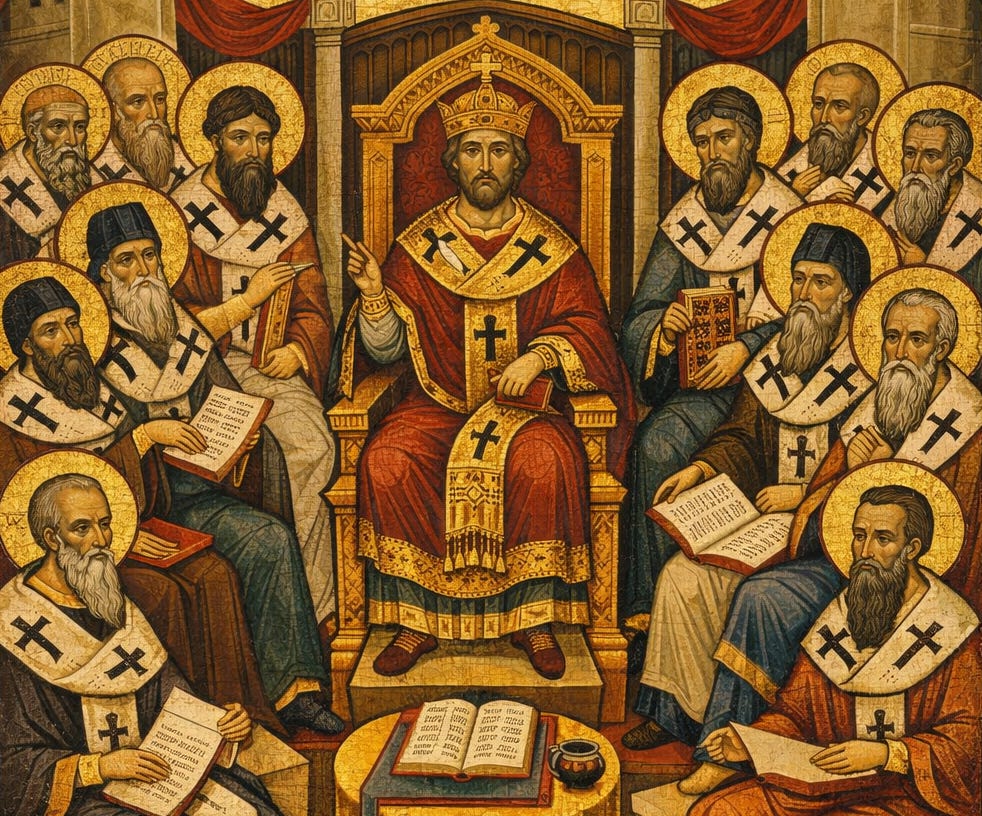
The famous Council of Nicaea (325) is well known to all of us, particularly after last year’s 1700-year anniversary. If the councils were like pop artists, they are normally known for one thing: for Nicaea, the famous Nicene creed. However, we don’t recite the original; we recite the later version, updated in Constantinople (381), and later, with the inclusion known as the Filioque clause (589/1024), which was one of the issues that led to the Great Schism between the Western and the Eastern Church in 1054.
What most people don’t know is that other canons were written and adopted by the Nicene Council. Twenty (20) to be exact. The ones that will be of interest to us are canon 19, as it addresses the topic of deaconesses. Historically, this is an important marker because it clearly shows that some parts of the church have women serving as deaconesses. Unlike Pliny, who was a Roman governor using the Latin term “ministrae”. Pliny had never attended a new member’s class and knew little about Christians. Pliny was an uniformed outsider.
However, the Council of Nicaea is different. Nicaea is a group of around 318 church leaders who discuss deep theological truths. The Nicene Creed set the boundaries of orthodoxy as taught in Scripture. The Creed is confessed in numerous languages across the globe every Lord’s Day. However, many know the famous Creed; the Canons are less popular. This article will look at Canon 19 and its importance for today’s discussion of the use of the title deaconess and their functions in the church. I hope to show that Canon 19 clarifies the reception status of Paulianist deaconesses and does not establish or endorse an ecclesial office.
Historical Context
The canons that follow begin to address issues within the church, such as the Meletian Schism. Canon 19 addresses a heretical group in Antioch, Syria, known as the Paulianists, named after Paul of Samosata (200–275). After his death, a group known as the Paulianists continued his teaching. His major error would be classed as Monarchianism, particularly the classification of Adoptionism technically (dynamic monarchianism). Paul of Samosata taught that God is one indivisible being of a single nature. In this framework, the Son was not co-eternal with the Father but rather understood as the man Jesus, who, because of God’s purpose and his own perfect life and obedience, was exalted and granted divine dignity.
Canon 19
This is where canon 19 comes in regarding how the church handles this group of people and their inclusion into the church. How would they handle those groups who called themselves Christians but were in fact heretics?
Concerning the Paulianists who have flown for refuge to the Catholic Church, it has been decreed that they must by all means be rebaptized; and if any of them who in past time have been numbered among their clergy should be found blameless and without reproach, let them be rebaptized and ordained by the Bishop of the Catholic Church; but if the examination should discover them to be unfit, they ought to be deposed.1
The canons address pastoral matters, including how to handle situations in which different groups have ordained clergy or claim to be Christians but fall outside scriptural orthodoxy. The canons address examinations and ensuring that the clergy adheres to the teaching of the church. Somewhat of an early version of what we would call subscription. The previous canon (18) makes it clear the distinction between Bishops and Presbyters in contrast to deacons, who were not to administer the Lord’s supper, and even prohibited from touching the elements prior to the bishop or elder.
In Canon 19, quoted above, you see that those seeking to join the Catholic Church must be ‘rebaptized’ because their first baptism was not a Trinitarian baptism. It also expresses that if any had been clergy, then they need to be tested to see if they are qualified for the office, and ‘rebaptized’ and ordained.
The canon then speaks of deaconesses, and other titles that might of been used by the Paulianists,
Likewise in the case of their deaconesses, and generally in the case of those who have been enrolled among their clergy, let the same form be observed. And we mean by deaconesses such as have assumed the habit, but who, since they have no imposition of hands, are to be numbered only among the laity.2
We need to understand that what this canon expresses is not a book of order as we would know it, but rather the question of the reception of this group seeking to join the church. They express what they mean as deaconess, as those who have assumed the habit. An ancient epitome of this canon says, “Deaconesses who have been led astray, since they are not sharers of ordination, are to be reckoned among the laity.”3 Canon 19 should not be read as the church’s overall approval of such a role, but rather as the church’s handling of the group seeking to become members of the church. The council is clear that these women, who were called deaconesses, were to join the church as laity, and not clergy.
Excursus: Didascalia Apostolorum
The Didascalia Apostolorum is a third-century church order, likely composed in Syria around the mid-200s. Though written in the voice of the apostles and long regarded as preserving apostolic instruction, modern scholarship understands it as a later document reflecting developing ecclesial practice. The original Greek text is lost, and the work survives chiefly in Syriac translation. As one of the earliest sustained witnesses to the role of deaconesses, the Didascalia provides important background for interpreting Canon 19 of Nicaea. The Didascalia states, “Andrew said, It would be very good, my brethren, that we should appoint women as Deaconesses.”4
Chapter 16 speaks of the appointment of Deacons and Deaconesses. The chapter makes it clear the distinctions, “The man who is elected is for many oversights that are required, but a woman for the service of the women; for there are houses where thou canst not send a Deacon to the women on account of the heathen.”5 Deaconesses were to assist in the baptism of women. The administration of baptism was to be done by the Priest,6 but the deaconess was given clear instructions of their function, “And when she that is baptized arises from the water let the Deaconess receive her, and teach her and educate her, in order that the unbreakable seal of baptism be with purity and holiness.”7 The Didascalia expresses that the Deaconess, is “necessary and obligatory.”8 It expresses that as Christ was served by women, so to the church has women who serve. The Disacscalia is clear of what ways women were to serve in the life of the church, “for in the houses of the heathen, where there are believing women, a Deaconess is required, that she may go in and visit those who are sick, and serve them with whatever they need, and anoint (S. wash) those who are healed from sicknesses.”9
While the title was used, it is clear that the function was seen to practically assist ordained leaders, particularly as they serve other women in their community or in the church. They had no liturgical functions other than assisting at baptisms.
The role of women serving as deaconesses in the church is evident in the churches of the latter half of the third and fourth centuries. While the practice is more regional, such as in Antioch, Syria, than universal. Some church fathers mention them, such as Chrysostom.
While the practice is found in the Eastern Churches, it is neither widespread nor institutionalized in the Western Church. However, though the title is used, in some regions, it is clear that the functions of those who assist the ordained leaders are not ordained and are viewed as laity. Their roles are to serve other women, where it might be inappropriate for men to serve in those situations, such as during baptism by immersion.
Synodical Letter
The council wrote a letter to accompany the creed and canons, addressed various parties, including a schismatic group associated with Meletius of Lycopolis (Egypt). This synodical letter, while addressing a different schism than the Syrian–Deaconesses, reveals the broader Nicene concern for regulating claims to ecclesial office and authority. Unlike Paul of Samosata, who was heretical, Meletius was treated with more leniency. Meletius, began ordaining people outside of Church authority, mainly Alexandrian authority. While this letter does not discuss the Paulianist Deaconesses, it is helpful to see the broader context of the council as it relates to how they understood offices in the church are established. In this synodical letter, they provide this instruction:
“So that these men are to have no authority to make appointments of persons who may be pleasing to them, nor to suggest names, nor to do anything whatever, without the consent of the bishops of the Catholic and Apostolic Church, who are serving under our most holy colleague Alexander; while those who, by the grace of God and through your prayers, have been found in no schism, but on the contrary are without spot in the Catholic and Apostolic Church, are to have authority to make appointments and nominations of worthy persons among the clergy, and in short to do all things according to the law and ordinance of the Church.”10
Whereas the council is clear that individuals do not have the right to establish or appoint people to positions of authority without the permission of the Church in Alexandria. This reflects early tendencies toward regional episcopal oversight that later ecclesial developments would expand in various ways, including the magisterial authority in the Catholic church, which established a plethora of non-biblical offices and a non-biblical church hierarchy.
The Reformation sought to return to Scripture, particularly to Christ’s ordinances. Whereas the Synodical letter stipulated that Miletus was not to appoint any person to any clerical role without permission, the reformed Presbyterians stated that no man/ecclesiastical body has any right to carry out such a role. The authority of the church is solely ministerial and declarative, meaning Christ is the sole king and head of his church. Paulianists communities included women designated as deaconesses, and Miletus of Lycopolis was carrying out unlawful ordinations of his own, a variety of offices, some of which appeared he had created himself.
There was much discussion and debate among Presbyterians regarding the number of offices. They did not return to Canon 19, but to the Holy Scriptures. The Reformers had a variety of views, as some saw the Evangelist as an extraordinary office; three prevailing views were commonly represented in some form or another. Calvin (Doctor/Teacher, Minister/Pastor, Elder, and Deacon), Knox (Minister/Pastor, Elder, and Deacon), and American Presbyterians such as the PCA (Elders; two classes, Teaching and Ruling, and Deacons). To my knowledge, during this time, no Presbyterian Reformers regarded the ecclesiastical office of deaconess as biblical.
To my knowledge, no Reformed Presbyterian church had a distinction of deaconess in its book of church order until the 20th Century. While the RPCNA adopted the practice in 1888, the adoption of the Testimony of the RPCNA (1980) and the Directory for Church Government did not occur in the 20th Century. The ARP changed its form of government in the early 1970s. The PUSA and PCUS have a different story, which is the historical foundation for the establishment of the PCA and their position on who is qualified to serve in the ordained office.
Conclusion
Canon 19 is helpful to be able to see that there was a small heretical sect of people who called themselves Christians who had women serve as deaconesses. The council was clear that if they truly were professing Trinitarian Christians, then they should be welcomed into the church and be admitted through baptism. However, it was also very clear that deaconesses were not ordained officers in the church and were to be considered as laity. Canon 19 speaks about the reception of a heterodox community, not the constitution of an office. This was not an establishment of the role of deaconesses, nor could we say it was an approval of such a role. Even if it was, we know the function of this role was to assist ordained officers with sensitive matters involving women in the church. The modern discussion appears drastically different from the ancient evidence. Whereas early witnesses describe deaconesses primarily in relation to practical concerns of modesty, access, and assistance, contemporary discussions frequently engage the category through questions of representation, visibility, seats at the table, office, and parity. Those who use historical references such as canon 19 rarely cite it to see deaconesses serve as they did in 325, but to see a whole different role and function expressly set down in scripture, nor found through good or necessary consequence. As I have mentioned many times before, Christ has ordained his officers and offices for his church to edify and build up the church so they can carry out the ministry to which they are called.
[Christ, as Head of His Church,] gave all the offices necessary for the edification of His Church and the perfecting of His saints (Ephesians 4:10-13).
It belongs to His Majesty from His throne of glory to rule and teach the Church through His Word and Spirit by the ministry of men; thus mediately exercising His own authority and enforcing His own laws, unto the edification and establishment of His Kingdom.
Christ, as King, has given to His Church officers, oracles and ordinances; and especially has He ordained therein His system of doctrine, government, discipline and worship, all of which are either expressly set down in Scripture, or by good and necessary inference may be deduced therefrom; and to which things He commands that nothing be added, and that from them naught be taken away.
Preface of BCO
Henry R. Percival, “The Canons of the 318 Holy Fathers Assembled in the City of Nice, in Bithynia,” in The Seven Ecumenical Councils, ed. Philip Schaff and Henry Wace, vol. 14 of A Select Library of the Nicene and Post-Nicene Fathers of the Christian Church, Second Series (New York: Charles Scribner’s Sons, 1900), 40.
Henry R. Percival, “The Canons of the 318 Holy Fathers Assembled in the City of Nice, in Bithynia,” in The Seven Ecumenical Councils, ed. Philip Schaff and Henry Wace, vol. 14 of A Select Library of the Nicene and Post-Nicene Fathers of the Christian Church, Second Series (New York: Charles Scribner’s Sons, 1900), 40.
Henry R. Percival, “The Canons of the 318 Holy Fathers Assembled in the City of Nice, in Bithynia,” in The Seven Ecumenical Councils, ed. Philip Schaff and Henry Wace, vol. 14 of A Select Library of the Nicene and Post-Nicene Fathers of the Christian Church, Second Series (New York: Charles Scribner’s Sons, 1900), 40.
Margaret Dunlop Gibson, trans., The Didascalia Apostolorum in English, vol. II of Horae Semiticae (London: Cambridge University Press Warehouse; C. J. Clay and Sons, 1903), 17.
Margaret Dunlop Gibson, trans., The Didascalia Apostolorum in English, vol. II of Horae Semiticae (London: Cambridge University Press Warehouse; C. J. Clay and Sons, 1903), 78.
Particularly the instruction of the pronouncement, “Let a man repeat over them the names of the invocation of the Godhead in the water.”
Margaret Dunlop Gibson, trans., The Didascalia Apostolorum in English, vol. II of Horae Semiticae (London: Cambridge University Press Warehouse; C. J. Clay and Sons, 1903), 78–79.
Margaret Dunlop Gibson, trans., The Didascalia Apostolorum in English, vol. II of Horae Semiticae (London: Cambridge University Press Warehouse; C. J. Clay and Sons, 1903), 79.
Margaret Dunlop Gibson, trans., The Didascalia Apostolorum in English, vol. II of Horae Semiticae (London: Cambridge University Press Warehouse; C. J. Clay and Sons, 1903), 79.
Philip Schaff and Henry Wace, eds., “The Synodal Letter,” in The Seven Ecumenical Councils, trans. Henry R. Percival, vol. 14 of A Select Library of the Nicene and Post-Nicene Fathers of the Christian Church, Second Series (New York: Charles Scribner’s Sons, 1900), 53.