
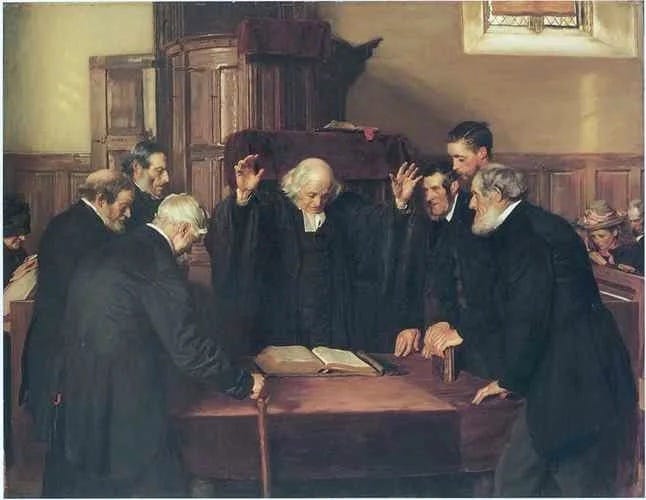
Ordination is a divine appointment. It is neither a ritual of human invention nor a simple gesture of congregational approval. It is the Church acknowledging the call of Christ, the King and Head of His Church, who gives officers for the edification and perfection of His people (Eph 4:11-12). Whenever we gather to ordain elders or deacons, we witness Christ Himself appointing His servants for His flock. Ordination is not a routine ceremony but is placed within gathered worship because it publicly declares the kingship of Christ over His Church and impresses upon us the solemnity of the vows made before God and His people.
There are many ways to handle and discuss a topic of Ordination. Perhaps one day, a more comprehensive work could be done on the subject, allowing us to see the great blessing that this ordinance is, a blessing Christ has bestowed upon His church. In this article, we will walk through an ordination service, helping to understand what is happening along the way. Most readers will not require an exhaustive treatment of ordination, yet many will participate in a worship service where elders or deacons are set apart to serve Christ’s Church. I am following the Book of Church Order, which follows the same order for Teaching Elders, Ruling Elders, and Deacons, although Teaching Elders have their own chapter (BCO 21).
Before the Service
Before the day of ordination, many things must take place; ordination is not a fast process, and it should not be, as Paul warns Timothy (1 Tim 5:22). I have written a brief glossary of these terms (Words Matter). The first step is that the candidate must have an inward and personal call to ministry (1 Tim 3:1). A good book on the subject is “Called to Ministry” by Edmund Clowney.[1] When the father of a deacon in our church observed the careful process involved in preparing his son for the office of deacon, he remarked on how he himself had become a deacon years earlier: “The pastor asked me, and I said yes.” The Presbyterian model is different. It is not left to an individual, nor even to a small group, to determine that a man is called. God must call him, he must be trained and examined, elected by the congregation, ordained by the Church, and equipped by Christ for the work.
The next step is nomination. Nomination is the broadening of the call to ministry, seeking not only the man’s own conviction but the church’s confirmation. Others within the body must see evidence of God’s call in his life. This is not a question of whether he is a good businessman or administrator, but whether he is a qualified, godly man (1 Tim 3; Tit 1). Does he display Christlike character, humility, and faithfulness? The church’s task is not to identify the most capable but the most Christlike, those whose lives already bear the marks of the office to which they may be called.
After the nomination phase, the training and equipping of the person for ministry is often the period of time spent at seminary, particularly for those looking to serve as Teaching Elders. During this time, the church should not see its role as external; we do a great disservice when we believe someone else is doing a particular job. The church should be significantly involved in the man’s life during the time of training (not just at seminary). The candidate’s character needs to be a vital part of training, not merely intellectual knowledge. Following the time of training comes the examination, which tests the man according to the qualifications found in 1 Timothy 3 and Titus 1. A man examined for ordination in the PCA is evaluated in three areas: his Christian character and calling, his knowledge, views, and competency for ministry (Scripture, theology, sacraments, church history, church government, and original languages when required), and his commitment to the vows and duties of the office (BCO 21–4; 24–1).
Following examination, the final step before ordination is that of election. This is one of the strangest portions of Presbyterian polity; the congregation votes to elect those who will exercise authority over them (PP 6). We do not become Congregationalists for a short season in our polity, nor do we temporarily adopt the principles of democracy. The election of officers in Christ’s Church is not based on the will of the majority but on the discernment of Christ’s call. In the American context, we may be tempted to think of election through the lens of “We the people,” but the New Testament pattern is not democracy; it is submission to the rule of Christ through His appointed means. Presbyterian polity, even outside the United States, has consistently recognized that election is the church corporately discerning the will of Christ, not asserting the sovereignty of the people. The Scots stated, “He is to be examined and approved by those by whom he is to be ordained.”[2] (cf. 1 Tim 3:7, 10). They make sure that this man is qualified, even if he has passed his examinations; if he is unqualified according to the Word of God, he should not be ordained. The Scots explained, “No man is to be ordained a minister for a particular congregation, if they of that congregation can show just cause of exception against him.”[3]
More could be said about each of these significant steps. Even in much greater detail, about how our BCO seeks to safeguard the process, particularly for Teaching Elders (cf. James 3:1). For Teaching Elders, the path toward ordination includes becoming a candidate with the session’s endorsement, undergoing training and growth in competency (Licensure and Internship), submitting frequent reports to Presbytery, receiving a call to ministry, and facing thorough examinations. All of this intentional time and testing underscores the great weight and solemnity of what follows in the ordination of a man.
Meeting of the Court
When the day of ordination arrives, the first thing to recognize is that although ordination takes place during a worship service, it is in fact a meeting of a court.
Those who have been called to office in the Church are to be inducted by the ordination of a court (BCO 17–2).
Many have attended a Session or Presbytery meeting without realizing it, for ordination itself is such a meeting of the court. This, although it may seem minor, is significant to understand who is performing the ordination. We are not Episcopalians, who hold that a bishop ordains a man, nor Congregationalists, who believe the authority to ordain rests with the congregation. In Presbyterian polity, it is the council of elders, the presbyterion, who lay hands on the ordinand and ordain him (1 Tim. 4:14). Presbyters gather to carry out their responsibility as a court in Christ’s Church (BCO 12–5.a, 13–9.a). This is why minutes are recorded for ordination and installation services. Ordination is not a private event but a public act of the court, either the Session or the Presbytery.
Again, we cannot move past this critical point. The court does not exercise authority because the people have granted it; it represents Christ and His authority, which He has given, and is ministerial and declarative (PP 7; BCO 11–2). This power is only granted through the official channels of the church’s courts.
Preaching of the Word
The next aspect that we cannot miss is that the Word must be preached. Not only do we need to understand that all authority granted and given to the church comes through the King and Head of the Church, but we also see this as all sit under the preached word. All His people need His Gospel, which is given through the preaching of the Word. All of Christ’s people need God’s word, even those who will preach God’s word. Ordained officers must realize their need for Christ.
Ordination is weighty, but it is not salvation. A man may be ordained and yet lost; he may be unordained and yet belong to Christ. Christ alone saves.
Before elders are called to shepherd, they must know the Good Shepherd. Before Deacons show mercy, they must know the Merciful Servant. Before a person kneels for ordination, they must kneel before God in all humility.
Solemnity of Ordination
The next section in the service provides instructions for those present on what they will be participating in. This is no formality, nor is it a magic show. The ordination of a man set apart for ordained office is one of seriousness and great gravity. We often encourage people to pray before an election of officers, but we also should spend time in prayer and fasting for the ordination (Acts 13:3). Our churches frequently do not practice fasting; if there ever were a time in the life of a church to begin this practice, before an ordination service would be a fitting place to begin.[4] Read more on Fasting by Samuel Miller.
Reverence is not coldness. Ordination is a profound moment in the life of the ordinand, congregation, and the church. All before God, take vows in which the person swearing solemnly calleth God to witness what he promises and to judge him according to the truth or falsehood of what they swear (WCF 22.1). Vows ought to be made with religious care, with weightiness of the solemn act, and to be performed with faithfulness (WCF 22.5). People should be instructed and warned before making any lawful vow, so they might know the grave and solemn truth of what they swear.
Ordination Vows
After being instructed in the solemn nature of vows, the vows are to be asked of the ordinand and then the congregation. The vows taken by an ordinand in the PCA have remained very similar since the 1789 Form of Government (See History of BCO 21–5). I would encourage all men seeking ordination, or even if ordained, to review these vows and ask the Lord to help them fulfill these vows faithfully. One vow worth highlighting is the ordination vow for Ruling Elders and Deacons (Question 4) and for Ministers (Question 7).
In this vow, the officer affirms the divine designation of his office, the sphere and nature of its duties, and his calling to serve as a model of godly example for others to follow. He acknowledges his accountability both to the flock and to the brethren with whom he serves, all with a steadfast eye toward fulfilling this call with faithfulness to the end.
Following the reading of this vow by the presiding officer, the man responds, “I do.” It is one of the smallest sentences he will ever speak, once to his bride on his wedding day, and again before Christ and His Bride on his ordination day. Yet this small sentence carries an enormous weight, an undertaking that can only be fulfilled by the empowering grace of the Holy Spirit.
After the ordinand has taken his vows, the congregation is likewise called to respond. This vow, though brief, is a solemn act of covenant faithfulness, joining the people to their officers under Christ’s government. When the presiding minister asks, “Do you, the members of this church, acknowledge and receive this brother…?” the congregation answers together, “We do.” In that simple phrase, the flock pledges to honor Christ’s order, to support His servant, and to yield obedience in the Lord to those whom God has set over them. As Scripture exhorts, “Remember your leaders, those who spoke to you the word of God” and “Obey your leaders and submit to them, for they are keeping watch over your souls” (Heb. 13:7, 17). It is not the voice of mere formality, but of faith, an acknowledgment that Christ Himself rules His Church through the men He calls. Just as the ordinand’s “I do” binds him to serve with humility, the congregation’s “We do” binds them to follow with love, encouragement, and reverent submission, that together shepherds and flock might adorn the gospel and build up the body of Christ.
These are not vows made before men, but before God, as the witness who will judge them according to the words in which they have promised. Similarly, when a person joins the Church, they make a similar vow: “Do you submit yourselves to the government and discipline of the Church, and promise to study its purity and peace?”
The Act of Ordination
Finally, the actual portion we think about in the ordination. Once more, there are more critical items at work here than merely a prayer.
The BCO explains,
“Ordination is the authoritative admission of one duly called to an office in the Church of God, accompanied with prayer and the laying on of hands, to which it is proper to add the giving of the right hand of fellowship” (BCO 17–2).
The first is the posture of the man to be ordained. He kneels, showing what was heard before in the preached word; he boasts not in himself but in humble reliance seeks to serve his Lord and Master. This symbolic posture should not merely reflect the beginning of his service but his life of service as an ordained officer. As Robert Murray M’Cheyne affirmed, “What a man is on his knees before God, that he is, and nothing more.”
The second portion of the act of ordination is both the prayer and the laying on of hands upon the candidate. This practice comes directly from Scripture. In the Old Testament, Aaron was ordained as a priest (Ex. 40:12–15), Joshua as the successor to Moses (Deut. 34:9), David as king (2 Sam. 5:1–5), and Elisha as a prophet (1 Kings 19:16, 19–21). In the New Testament, the same pattern continues; men are ordained to church office (Acts 6:6; 13:3; 1 Tim. 4:14; 2 Tim. 1:6), and commands are given for the ordaining of others (1 Tim. 5:22; Titus 1:5). In the New Testament, we find ordination come through the laying on of hands. This gesture is unique to ordination, and therefore, we must be careful not to diminish its significance by applying its language or symbolism loosely to other occasions. We may join hands or link arms in prayer, but the biblical language of “laying on of hands,” or “they laid their hands on him and prayed,” should be explicitly used for ordination, where it properly belongs. The act itself does not convey or grant the office to the man; only Christ has the authority to give offices to the church (Eph 4:11).
Ordination is neither superstitious nor merely symbolic. We see that Christ gifts the man with the gifts and abilities to carry out his function. James Bannerman puts it so well,
“It is not a charm; nor does it act like a charm in the way of imparting grace. But there are special promises connected with the office of the ministry, and special grace to be warrantably expected by all who are rightly called to the office; and in the act of admission to the office those promises may be claimed in faith, and those graces entreated for; and we have a right to believe that then and there the promise will be fulfilled, and the grace conferred.”[5]
He continues,
“And when the Church proceeds with prayer and imposition of hands to admit to the office, and when the person previously called by Christ seeks entrance to the office from the Church in a right spirit, it is no superstition, but a scriptural and reasonable faith, to believe that in ordination the promises will be found true, and the blessing will be made effectual.”[6]
Bannerman beautifully describes ordination as the Church’s open-handed act of faith, not a charm that imparts grace, but the solemn moment when Christ fulfills His promises and bestows the gifts necessary for the office. The Church prays; Christ gives. In the laying on of hands, the Church does not confer power but receives it, as the ascended Lord “gave gifts unto men” (Eph. 4:8-12). Ordination, then, is less than a charm but more than a form; it is the appointed means through which Christ invests His servants with grace for their ministry.
Only following ordination does a man have the right to exercise the authority given to him. Ordination is a divine appointment in which Christ exercises His authority through His elders, thus the gathering of the session or Presbytery. Unless extraordinary circumstances require (Titus 1:5; BCO 8–6), more could be said, but I encourage you to read Bannerman’s excellent exposition.
Following the prayer and laying on of hands, the elders are then to give the ‘right hand of fellowship.’ This is the culmination of the ordination act, as the elders gathered to ordain the man to his calling. He is now a brother who serves beside them, either as a fellow elder or a deacon, carrying out his ministry so that the elders may focus on their ministry of word and prayer.
Pronouncement of Ordination
Following the act of ordination is the official pronouncement of ordination. Just as the minister publicly announces the married couple of Mr. and Mrs., the public pronouncement is given by the ordained elder or deacon. This is not some magical spell that transforms the man into an officer, but a public and declarative recognition of Christ’s call on the man’s life. The public nature of Ordination is essential in the life of the church, as members are to ‘obey their leaders.’ Unless the officers are known to the congregation, who are they to obey?
Quick note about installation
Ordination and Installation are both connected yet distinct; a man is ordained once in his life, while being installed in various callings throughout his life. Ordination is the setting apart of a man to an office. Installation is the particular church where he will be exercising the functions of that office. A man cannot be ordained unless he has a call to be installed. We see that installation is still such a solemn event and needs to reflect that. Vows are taken, and a charge is given. Christ has already given them gifts to the man at his ordination; he is now charged to fulfill them at this particular church.
Charge
The serious and solemn nature of this act of ordination requires now a serious and solemn charge to the man to carry out his vows he has made before God in that particular calling.
“As every ecclesiastical office, according to the Scriptures, is a special charge, no man shall be ordained unless it be to the performance of a definite work” (BCO 17–3).
The man should know the solemn nature of ordination, but before he carries out any function of the office, he must be warned to be faithful to Christ and his calling, and also to be watchful. There are many warnings in Scripture of those who are in leadership of the church and yet do not fulfill the duties they are called to. Paul warns the elders on the beach of Miletus,
“Pay careful attention to yourselves and to all the flock, in which the Holy Spirit has made you overseers, to care for the church of God, which he obtained with his own blood” (Acts 20:28).
The elders are warned to pay attention to themselves. The warning speaks of how Satan seeks to destroy the church through sin in the hearts of the leaders. Fierce wolves are coming, Paul warns them, but they will come from among them. A gruesome image of a man set apart and called to shepherd God’s flock, whom Christ has paid for with His blood, and he feeds upon the sheep like a wolf and not a sheep (Jude 12, Ezekiel 34). The calling of the ordained office is not a small task. Christ is the chief shepherd, and he will hold His officers accountable (Heb 13:7; 1 Pet 5:1–4).
Not only is the ordained officer charged, but also the congregation. Just as both took vows before God, they are warned of their calling now to be sheep in Christ’s Church. They are to follow the example set by the leaders, be obedient to their scriptural commands, and lift them up in prayer that Satan might not lead them or others astray.
The charge is given, and so the church can carry out discipline on men who fail to fulfill their duties in the office (BCO 24–7; 34–10). This is one area of rotating sessions/diaconates that I believe needs to be clarified in the church’s bylaws if they have term limits. Ordination is for life, and besides providential situations, a man should be fulfilling his call to the office. If he does not, he should be disciplined for not using the gifts given to him by Christ for the edification and perfection of Christ’s Church. For Teaching Elders, this is a three-year period (BCO 13–2); the Presbytery needs to investigate the reason he is not fulfilling the functions of the office.
Christ’s Blessing
The service ends with a benediction, a blessing from God for His people. A glorious reminder, it is Christ who blesses His people. From start to finish, the service is the outworking of the glorious Preamble in the Book of Church Order,
“He, being ascended up far above all heavens, that He might fill all things, received gifts for His Church, and gave all offices necessary for the edification of His Church and the perfecting of His saints (Ephesians 4:10-13)… It belongs to His Majesty from His throne of glory to rule and teach the Church through His Word and Spirit by the ministry of men; thus mediately exercising His own authority and enforcing His own laws, unto the edification and establishment of His Kingdom.”
Ordination is not a man-made, magical, or meaningless practice; it is a foundational outworking of the Principle of Presbyterianism; Christ is King and Head of His Church, and he has appointed godly, qualified officers who serve His Church in the offices he has appointed, both Elders and Deacons.
[1] Edmund P. Clowney, Called to the Ministry (P & R Publishing, 1992).
[2] Westminster Assembly, The Westminster Confession of Faith: Edinburgh Edition (Philadelphia: William S. Young, 1851), 526.
[3] Westminster Assembly, The Westminster Confession of Faith: Edinburgh Edition (Philadelphia: William S. Young, 1851), 527, 528
[4] Westminster Assembly, The Westminster Confession of Faith: Edinburgh Edition (Philadelphia: William S. Young, 1851), 526.
[5] James Bannerman, The Church of Christ: A Treatise on the Nature, Powers, Ordinances, Discipline, and Government of the Christian Church (Edinburgh: T&T Clark, 1868), 470.
[6] James Bannerman, The Church of Christ: A Treatise on the Nature, Powers, Ordinances, Discipline, and Government of the Christian Church (Edinburgh: T&T Clark, 1868), 470.